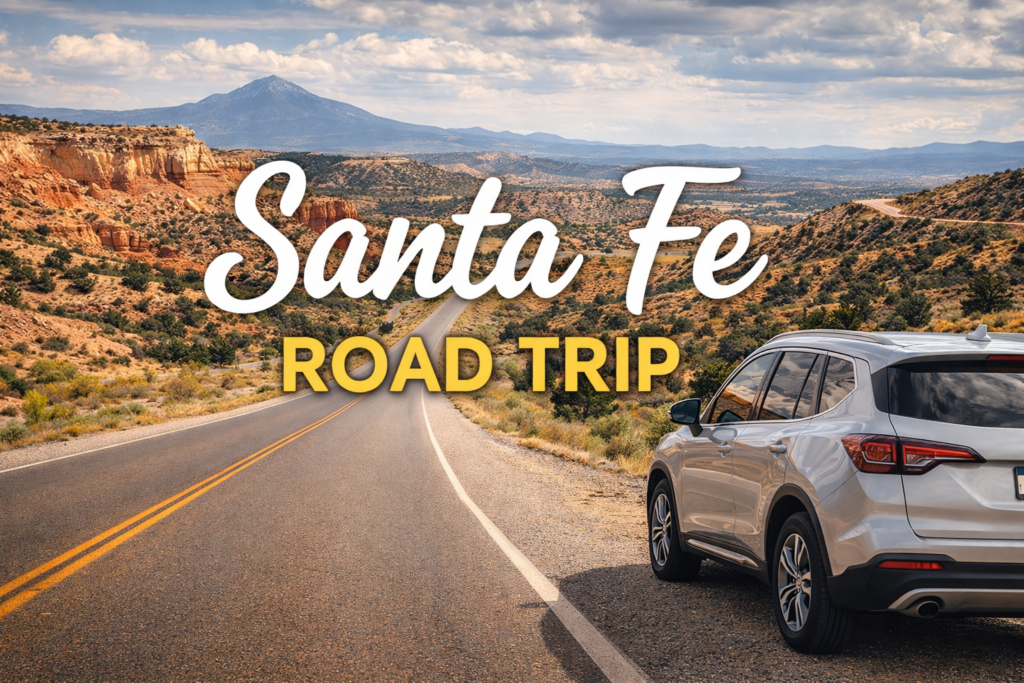
There is something about the drive into Santa Fe that stops you mid-sentence. The high desert air, the adobe buildings glowing amber in the late afternoon sun, the smell of pinon smoke drifting from somewhere you cannot quite place. New Mexico’s capital city sits at 7,000 feet above sea level and feels like nowhere else in America — part ancient pueblo culture, part art world capital, part genuine Wild West. This Santa Fe road trip itinerary is built for travelers who want more than a weekend getaway. Whether you are driving in from Albuquerque, flying into Santa Fe Regional Airport, or making this the centerpiece of a longer Southwest road trip, this guide covers every mile worth driving, every stop worth making, and every meal worth planning your day around. We have included hidden gems that most travel blogs skip, honest driving times, real cost breakdowns, and day-by-day planning so you can actually use this — not just save it and forget it.
Why Santa Fe Should Be Your Next Road Trip Destination
Santa Fe is the oldest capital city in the United States, founded in 1610 — more than a decade before the Pilgrims landed at Plymouth Rock. That history runs deep here. You feel it walking the narrow streets of the Plaza, you see it in the centuries-old adobe architecture that city law still requires, and you taste it in the red and green chile dishes that locals will passionately debate with anyone willing to listen. But Santa Fe is not a museum. It is a living, breathing city with one of the most vibrant art scenes in the country. Canyon Road alone has more galleries per square mile than almost anywhere in the world. The dining scene punches well above its weight for a city of 85,000 people. And the surrounding landscape — the Sangre de Cristo Mountains, the Rio Grande Gorge, the ancient ruins at Bandelier — gives road trippers an extraordinary natural playground within easy driving distance. For travelers coming from the UK, Europe, or the East Coast of the US, the Southwest in general and Santa Fe in particular offers a version of America that feels genuinely foreign and fascinating. This is not Times Square or the Vegas Strip. This is older, quieter, and far more interesting.
Santa Fe Road Trip at a Glance
Best time to visit: April–June and September–October
Ideal trip length: 5–7 days
Starting point: Albuquerque (most common) or Santa Fe directly
Total driving: 300–500 miles depending on route
Difficulty: Easy — all paved roads, well-signed highways
Budget per day: $120–$200 USD (mid-range traveler)
Luxury per day: $300–$500 USD
Must-have: Valid US driver’s license, car with good AC, offline maps
How to Get to Santa Fe
Flying In
Santa Fe Regional Airport (SAF) is small but convenient, with connecting flights through Dallas (American Airlines) and Denver (United). Direct flights are limited, so most travelers fly into Albuquerque International Sunport (ABQ) instead — a much larger hub with direct flights from most major US cities, London Heathrow, and other international destinations.
The drive from Albuquerque to Santa Fe is 65 miles north on I-25 and takes about one hour. It is a beautiful, easy drive through high desert landscape with the Sandia Mountains in your rearview mirror. Rent a car at the Albuquerque airport — you will absolutely need one for this road trip.
Driving
From Denver, Colorado: 6 hours south via I-25
From Phoenix, Arizona: 6.5 hours northeast via I-40 and I-25
From Dallas, Texas: 10 hours northwest via I-40
From Los Angeles: 13 hours east via I-40 (Route 66 country)
From Las Vegas, Nevada: 9 hours via I-15 and US-89
All routes are straightforward interstate driving with genuinely spectacular scenery, particularly the stretch through northern New Mexico on I-25 approaching Santa Fe from the south.
The Complete 7-Day Santa Fe Road Trip Itinerary
Day 1: Arrive in Albuquerque — Warm Up the Tires
Most road trippers begin in Albuquerque, so give yourself an afternoon and evening here before heading north. Albuquerque gets unfairly overshadowed by Santa Fe, but it has genuine character worth a few hours.
Start on Central Avenue in the Nob Hill neighborhood — a stretch of vintage Route 66 energy with independent coffee shops, bookstores, and great street art. Grab lunch at Frontier Restaurant, a legendary Albuquerque institution open since 1971 that serves green chile stew and sweet rolls to everyone from university students to road-weary truckers.
In the afternoon, walk Old Town Albuquerque. The historic plaza dates to 1706 and the San Felipe de Neri Church standing in its center has been in continuous use since 1793. The Albuquerque Museum next door is worth an hour for its Southwest history and art collections.
As the sun starts dropping, drive east to the Sandia Mountains and take the Sandia Peak Tramway — the longest aerial tramway in North America — up to 10,378 feet. The sunset view over Albuquerque and the Rio Grande valley from the top is one of those experiences that makes you put the phone down and just stand there.
Dinner in Albuquerque’s Barelas neighborhood or back in Nob Hill. Try Sadie’s Dining Room for red and green chile dishes that locals have been loyal to for decades.
Where to stay: Hotel Albuquerque at Old Town or Hyatt Regency Albuquerque downtown. Driving today: 0 miles (arrival day)
Day 2: Albuquerque to Santa Fe via the Turquoise Trail
Skip the interstate today. The Turquoise Trail — officially New Mexico State Road 14 — is a 50-mile National Scenic Byway that winds through the Sandia and Ortiz mountains and is far more rewarding than the hour-long slog up I-25.
Leave Albuquerque heading east on I-40 and pick up Route 14 near Tijeras. Your first stop is the village of Cerrillos, a former silver and turquoise mining town that looks almost exactly as it did in the 1880s. About 2,000 Westerns and film productions have used this tiny village as a backdrop. Walk the dirt streets, visit the Cerrillos Hills State Park trailhead, and have a coffee at the Black Bird Saloon if it is open.
Where to stay: La Fonda on the Trail (historic, on the Plaza), Inn of the Governors, or Ten Thousand Waves (Japanese mountain spa resort — splurge, but unforgettable) Driving today: 65 miles (approx 1.5 hours with stops)
Day 3: Deep Dive Into Santa Fe — Art, History & Green Chile
Give Santa Fe a full unhurried day. This city rewards slow walking more than any itinerary can convey.
Morning: Start at the Santa Fe Farmers Market in the Rail Yard district (open Tuesday and Saturday mornings, year-round). This is one of the best farmers markets in the Southwest — local produce, Hatch chiles, honey, handmade tortillas, tamales, and roasted piñon nuts that you will be thinking about for weeks afterward. Have breakfast here.
Lunch: Cafe Pasqual’s on Don Gaspar Avenue is a Santa Fe legend. Small, packed, and absolutely worth the wait for their huevos motuleños or the breakfast burrito smothered in both red and green chile — ordering “Christmas style” is the correct move.
Afternoon: The New Mexico History Museum and Palace of the Governors complex is one of the most underrated history museums in the country. Four floors of exhibits trace 10,000 years of human history in New Mexico, from the Ancestral Puebloans through Spanish colonization, the Santa Fe Trail era, the Manhattan Project, and into the present. Budget two hours minimum.
Sunset: Drive up Artist Road to the Hyde Memorial State Park area for panoramic views of Santa Fe and the surrounding desert as the light goes golden and the city’s adobe buildings seem to catch fire.
Dinner: The Shed on Palace Avenue has been serving traditional New Mexican food since 1953 in a rambling old adobe. The posole and the red chile enchiladas are the reasons people come back to Santa Fe.
Day 4: Bandelier National Monument & the Ancestral Puebloans
Today is the day that most visitors to Santa Fe completely miss — and the day that usually becomes the most memorable of the entire trip.
Bandelier National Monument is 46 miles northwest of Santa Fe (about an hour’s drive) and contains some of the most accessible and awe-inspiring ancestral Puebloan ruins anywhere in the Southwest. People lived in these canyon walls — literally in caves carved into the volcanic tuff cliffs — for over 400 years before abandoning the site around 1550 AD.
On the way back to Santa Fe, stop in Los Alamos for lunch. The Bradbury Science Museum tells the fascinating and sobering story of the Manhattan Project, which was conducted entirely in secret at this isolated plateau location during World War II. It is free, well-designed, and thought-provoking.
Back in Santa Fe by late afternoon. Evening is yours — browse the galleries still open on Canyon Road, find a rooftop bar, or book a treatment at Ten Thousand Waves spa up in the mountains above town.
Driving today: 92 miles round trip Entry fee: $25 per vehicle (National Parks Pass covers this — worth buying if doing multiple parks)
Day 5: Taos — The Most Beautiful Drive in New Mexico
The High Road to Taos is 80 miles of winding mountain highway that passes through some of the most beautiful and least-visited villages in New Mexico. Clear your morning early and take your time.
Leave Santa Fe north on US-84/285 and pick up Route 503 near Nambé. The road climbs immediately into the Sangre de Cristo foothills, passing through Chimayó — home to El Santuario de Chimayó, a small adobe church built in 1816 that is one of the most important Catholic pilgrimage sites in North America. The dirt in a small room beside the altar is considered holy by thousands of pilgrims who walk here each year during Holy Week. The church itself is simple, beautiful, and genuinely moving regardless of your beliefs.
Continue through the Hispanic mountain villages of Truchas and Las Trampas — Spanish Colonial settlements whose residents have farmed the same high mountain valleys for three and four centuries. Stop at Truchas overlook for a view of the Rio Grande valley and the Taos Plateau that will make you check your camera is actually capturing what your eyes are seeing.
On the way back to Santa Fe, take the Low Road — Route 68 south through the Rio Grande Gorge. Stop at the Rio Grande Gorge Bridge, 650 feet above the river, for one of the most vertigo-inducing views in the American Southwest.
Arrive back in Santa Fe by evening. Driving today: 160 miles (about 4 hours with stops)
Day 6: Ghost Ranch, Abiquiú & Georgia O’Keeffe Country
If you have seen any painting by Georgia O’Keeffe — the red and ochre cliffs, the bleached animal bones, the strange mesas rising from flat desert — then you already know this landscape, even if you have never been here.
Ghost Ranch is 60 miles north of Santa Fe on US-84 and the drive itself is worth the trip. The Piedra Lumbre valley opens up around Abiquiú in a panorama of red, pink, yellow, and white cliffs that looks genuinely surreal — like a landscape from another planet that someone has painted in oil.
Ghost Ranch was O’Keeffe’s home and studio for decades and is now an education and retreat center open to the public. The Florence Hawley Ellis Museum of Anthropology and the Ruth Hall Museum of Paleontology (a T. rex skeleton was discovered on this land in 1947) are both on the property and both free with admission.
Back in Santa Fe by late afternoon. Last evening in the city — treat yourself to dinner at Geronimo on Canyon Road, consistently ranked among the best restaurants in New Mexico. The elk tenderloin and the green chile cheeseburger are both legendary, depending on how formal you want your last Santa Fe meal to be.
Driving today: 120 miles round trip
Day 7: White Sands or Head Home
If you are flying out of Albuquerque, the drive south on I-25 takes about an hour and gives you time for one last stop.
Option A — For Early Flights: A final morning walk on the Santa Fe Plaza while the city is quiet, coffee at Collected Works Bookstore and Coffeehouse on Galisteo Street (the best independent bookshop in New Mexico and a genuine community institution), then south to Albuquerque.
Option B — For Afternoon or Evening Flights: Take the Bosque Trail in Albuquerque’s Rio Grande Nature Center — a peaceful cottonwood forest walk along the river that feels completely removed from urban life and is a perfect decompression from a week of driving.
Santa Fe Road Trip Cost Breakdown
Budget Traveler (Per Day)
Accommodation: $80–$110 (budget hotels, Airbnb, motels)
Food: $30–$45 (taquerias, casual restaurants,
Gas: $15–$25 (depending on vehicle and daily mileage)
Activities: $10–$25 (most sites are low-cost or free)
Total per day: $135–$205
7-day trip total: $950–$1,435
Luxury Traveler (Per Day)
Accommodation: $350–$600+ (La Fonda, Bishop’s Lodge, Ten Thousand Waves)
Food: $120–$200 (Geronimo, Eloisa, rooftop bars)
Gas: $25–$40
Activities: $80–$150 (private tours,
Total per day: $575–$990
7-day trip total: $4,025–$6,930
Best Time to Take a Santa Fe Road Trip
Spring (April–June) — Best Overall
Spring is the sweet spot for a Santa Fe road trip. Temperatures in the city range from 50°F to 75°F (10–24°C) — perfect for hiking, walking Canyon Road, and spending long evenings outdoors. The surrounding mountains still have snow on their peaks while the desert floor blooms with wildflowers.
Crowds are present but manageable. Hotels are at mid-range pricing. The Farmers Market is in full swing by May. This is the season most photographers and artists prefer.
Fall (September–October) — Close Second
Fall in northern New Mexico is staggeringly beautiful. The aspen trees in the Sangre de Cristo Mountains turn gold in late September and early October, and the drive up Artist Road or into the mountains above Taos during peak color is one of the great autumn experiences in the American West.
Temperatures are ideal — warm days, cool nights. The International Folk Art Market wraps up by mid-July but the Santa Fe Wine and Chile Fiesta in late September is a fantastic event to time your trip around.
Summer (July–August) — Crowds and Monsoons
Summer brings the famous Santa Fe monsoon season — dramatic afternoon thunderstorms that roll in from the south almost daily between mid-July and mid-September. Mornings are clear and beautiful, afternoons can be spectacular (in both the visual and the weather-related sense of that word).
This is peak tourist season with corresponding hotel prices and crowd levels. The Spanish Market and Indian Market both happen in July and August respectively and are worth planning a trip around if you can handle the crowds.
Winter (November–March) — Hidden Gem Season
Winter is underrated for Santa Fe. The city handles snow gracefully — the adobe buildings look extraordinary dusted white, farolito (paper bag lantern) displays light the Plaza and Canyon Road on Christmas Eve in a tradition that goes back centuries, and hotel prices drop significantly.
Ski Santa Fe opens in late November or December and the Sangre de Cristo Mountains offer genuine high-altitude skiing within 30 minutes of downtown. Just prepare for cold nights — temperatures drop below freezing regularly from December through February.
Essential Packing List for a Santa Fe Road Trip
Layers are everything in northern New Mexico. The elevation means temperature swings of 30–40°F between morning and afternoon are normal even in summer. Pack accordingly.
Sun protection: Sunscreen SPF 50+, sunglasses, wide-brim hat. At 7,000 feet, UV exposure is significantly higher than at sea level. Most visitors are surprised by how quickly they burn.
Water: Carry more than you think you need. The high desert climate is deceptively dry and dehydration is a real issue, especially for visitors arriving from coastal or low-elevation cities.
Cash: Many of the Native American artisans at the Palace of the Governors portal and at Taos Pueblo prefer or require cash. Small bills are useful at roadside stands and village markets.
Offline maps: Cell service gets patchy on the High Road to Taos and in the mountain areas around Ghost Ranch. Download your route on Google Maps or Maps.me before leaving Santa Fe each morning.
Practical Tips for International Travelers
For UK & Other Travelers
Fly into Albuquerque (ABQ) via a US hub — Dallas, Atlanta, Denver, and Chicago all have good onward connections. British Airways, Virgin Atlantic, and American Airlines all operate transatlantic routes to US hubs with straightforward connections to ABQ.
Driving is on the right side of the road. Speed limits are in miles per hour. Distances will seem enormous by British standards — 60 miles feels like nothing out here. Roads are excellent and very well-signed.
Your UK driving license is valid for driving in the US. An International Driving Permit is not required but some rental car companies prefer it — worth checking in advance.
Tipping: 18–22% at restaurants is standard in New Mexico. Hotel housekeeping $2–5 per night. Gas station attendants in New Mexico pump your fuel for you in some areas — $1–2 tip is appreciated.
For Indian Travelers
Albuquerque has direct Delta and United connections from New York, Chicago, and other major US cities where Indian carriers operate. Most visitors from India routing through the US find a New York or Chicago connection the most practical.
New Mexico has a small but warm Indian community in Albuquerque and Santa Fe, and you will find a couple of decent Indian restaurants in both cities if you need a break from chile and posole.
Frequently Asked Questions About the Santa Fe Road Trip
Five to seven days gives you time to experience Santa Fe properly along with essential day trips to Taos, Bandelier, and Ghost Ranch. A three-day weekend trip is possible but you will only scratch the surface. If you can take a full week, you will leave feeling like you actually understood the place rather than just passed through it.
The classic route flies into Albuquerque, drives north to Santa Fe via the scenic Turquoise Trail, uses Santa Fe as a base for day trips to Taos via the High Road, Bandelier National Monument, and Ghost Ranch, then returns south to Albuquerque via I-25. This loop covers the absolute highlights without excessive backtracking and suits both first-time and returning visitors.
Absolutely — and in many ways it is more rewarding for international visitors because the cultural contrast is so striking. The combination of Native American, Spanish Colonial, and contemporary American culture in a single small city is genuinely unique. Visitors from the UK, Europe, and India consistently rate Santa Fe among their most memorable American experiences precisely because it feels so unlike anything else they have seen.
New Mexican cuisine is its own distinct food culture. The absolute must-try dishes are red and green chile — ordering “Christmas” gets you both on the same plate — posole, carne adovada, sopapillas with honey, and the legendary green chile cheeseburger that New Mexico claims as its own invention. Most restaurants in Santa Fe take their chile seriously and the quality difference from what you find elsewhere in the US is immediately obvious.
April through June and September through October are the ideal windows. Spring brings mild temperatures, wildflowers, and manageable crowds. Fall delivers stunning golden aspen color in the surrounding mountains and the Santa Fe Wine and Chile Fiesta in late September. Summer is peak season with higher prices and afternoon monsoon storms. Winter is underrated — beautiful snowfall on adobe buildings, excellent skiing nearby, and significantly lower hotel rates.
Budget travelers can manage on $135–$205 per day covering accommodation, food, gas, and activities. Mid-range travelers spending on boutique hotels and nicer dinners should expect $260–$390 per day. A full seven-day trip costs roughly $950–$1,400 on a budget or $1,800–$2,700 for a mid-range experience. Luxury travelers staying at La Fonda or Bishop’s Lodge can easily spend $500–$900 per day.
Yes, a car is essential. Santa Fe itself is walkable in the downtown and Canyon Road areas, but the day trips to Taos, Bandelier, and Ghost Ranch are impossible without your own vehicle. Rent a car at Albuquerque airport when you land — it is the most cost-effective option. A standard sedan handles all roads on this itinerary comfortably. An SUV gives you more flexibility if you want to explore unpaved forest roads.
Layers are the most important thing to pack. The high altitude means temperature swings of 30 to 40 degrees Fahrenheit between morning and afternoon are completely normal, even in summer. Bring strong sunscreen — UV exposure at 7,000 feet is significantly higher than at sea level. Comfortable walking shoes for town and proper hiking footwear for trails. Download offline maps before leaving each morning as cell service gets patchy on mountain roads and in the Taos area.